Climbing the Sacred Mountain of Doctoral Legitimacy
〞Cómo citar este artículo:
APA (7ª edición)
Spencer, H. (2025, December 14). Climbing the Sacred Mountain of Doctoral Legitimacy. En {dp} · doble página. https://herbertspencer.net/2025/climbing-the-sacred-mountain. Visitado en:
MLA
Spencer, Herbert. "Climbing the Sacred Mountain of Doctoral Legitimacy." {dp} · doble página, 14 December 2025, https://herbertspencer.net/2025/climbing-the-sacred-mountain. Accedido el .
Chicago
Spencer, Herbert. "Climbing the Sacred Mountain of Doctoral Legitimacy." {dp} · doble página. Publicado el 14 de December de 2025. https://herbertspencer.net/2025/climbing-the-sacred-mountain. Consultado el .
From Valparaiso to Tamaki Makaurau
I am undertaking a practice-led doctorate1 at Auckland University of Technology (AUT), in Aotearoa New Zealand.
From the perspective of my academic trajectory in Chile, this step is less a personal milestone than a structural necessity. In my school, postgraduate education and research have been consolidating over time, and doctoral participation shapes supervision capacity, research culture, and institutional responsibility. I write from within that system, with the intention of inhabiting it fully and contributing to it as a future supervisor.
This doctorate sits within a longer institutional relationship. Some years ago, our faculties initiated a collaboration grounded in the recognition of shared conditions as schools of the so-called Global South. The aim was not to imitate distant centres of authority, but to cultivate closer references, shared concerns, and a strong commitment to making as a mode of inquiry. In architecture and design, knowledge often emerges in the encounter with a work-in-progress: with materials, constraints, people, and contexts. That encounter has an irreducible character. It produces outcomes that cannot be fully anticipated, because the work is shaped by contingencies and negotiations that exceed any single plan.
Both New Zealand and Chile operate, culturally and academically, with what I would describe as an island mindset. Despite strong local traditions of practice and thought, there is a persistent tendency to seek external validation, from standards, frameworks, and evaluative models perceived as more authoritative because they originate in larger or more central academic systems. This tendency produces a familiar paradox: even when we are critical of imported frameworks, we can end up defending them with greater rigidity than their original proponents. The borrowed model becomes something to protect rather than something to work with.
Practice-oriented expectations
The promise of practice-led research is clear: practice is not an illustration of theory; it is a primary site where knowledge is generated, tested, revised, and made communicable. The artefact carries epistemic weight, while the exegesis clarifies how that work constitutes research within a university context.
I will confess something. In my unforgivable innocence as a young fifty-something, I imagined that choosing a practice-led format would spare me the minutiae of a conventional written thesis. I would be free, at last, to focus on the delicious making: building prototypes, designing systems, testing ideas with real people in real situations. The writing would be a brief, lucid companion to the artefact. A postscript with footnotes. A love letter to the thing itself.
This turned out to be spectacularly wrong. The written component of a Format 3 doctorate is not lighter than a conventional thesis; it is, in many ways, more demanding. You still need the full theoretical apparatus, the contextual review, the methodological framing, the rigorous argumentation. But on top of that, you must also produce the artefact, and articulate what it knows that the text alone cannot say. A Format 3 is not a shortcut. It is a Format 1 plus a Format 2, compressed into a single candidature. The work is double. The innocence was mine.
This format responds to a long-standing issue in design education. Projective disciplines already operate with forms of rigour that do not resemble laboratory protocols. They organise inquiry through iteration, critique, rehearsal, prototyping, and situated judgement. Method, in this sense, is often a living arrangement rather than a fixed procedure. When a university recognises practice-led research, it is making room, at least in principle, for that arrangement to count as doctoral work.
Yet the university also inherits expectations from other research traditions. It expects a research question that can be stated cleanly; a rationale that can be summarised quickly; a method that can be described as a stable sequence; an output that can be audited under examination conditions. These expectations can coexist with practice-led inquiry, and I have come to appreciate the discipline they impose. The tension between them is not a defect; it is the productive friction through which the work becomes examinable without ceasing to be genuine.
Pressure and Diamonds
In my first evaluated doctoral milestone, my project was perceived as too diffuse, too broad, and too ambitious. The critique focused less on the topic itself than on questions of viability and focus. I was told, in effect, that the project did not yet fit the shape of an examinable doctorate. I have kept those materials public as a record of this negotiation2.
I will be honest: it stung. Not because the feedback was unfair, most of it was not, but because I could not understand how a project this interesting could fail to communicate itself. I had spent years building towards it. The connections were alive to me: the AAC pictograms, the generative systems, the participatory design, the philosophical underpinnings. It all held together beautifully, from inside. From outside, apparently, it looked like a man trying to fit an entire continent into a suitcase.
That gap between inner conviction and outer legibility is, I think, a universal doctoral experience. You fall in love with the scope of your own inquiry and then discover that love is not an argument. Colleagues are not being obtuse when they ask you to narrow down. They are doing you the favour of reading your work as examiners will: from cold, without the benefit of your enthusiasm.
The feedback forced me to distinguish between the project as I experienced it, branching, relational, full of connections I wanted to preserve, and the project as it needed to be communicated: bounded, verifiable, examinable. The question was never whether to accept that constraint, but how to accept it without losing the spirit of the inquiry.
Precision and Communicability
One piece of advice I received early on was that the project should be easy to explain, quickly, to someone outside the field. I understand the motive. In an institutional environment where examiners compare projects across disciplines, communicability serves as a safeguard. It protects the system’s capacity to evaluate, and it protects the candidate from drifting into an unfinishable thesis.
But there is a tension here that deserves to be named, because it is the same tension that runs through every discipline that has ever needed its own vocabulary. Disciplines invent terms because they are necessary. A physicist does not say “the thing that makes stuff fall” because gravity does precise work that a paraphrase cannot. An architect does not say “the empty part” because void carries specific design meaning. A speech-language therapist does not say “picture cards” because augmentative and alternative communication names a field with its own epistemology, its own evidence base, its own professional ethics.
Oversimplification, presented as a virtue, can become a form of damage. It favours communicability at the expense of what is being communicated. And this is not a minor stylistic concern; it is the oldest debate in the book: form versus content. When the demand for accessibility erodes the conceptual structure of a project, the form has consumed the content it was meant to serve. The suitcase is now lighter, yes, but half the clothes are missing.
The answer, I think, is not to resist simplification but to practice it with care: to find the compression that preserves essential structure, the way a good map simplifies terrain without lying about the mountain.
The format as integrity
A doctoral format, when it works well, is a form of integrity. It asks the candidate to make every commitment explicit: this is my question, this is my method, this is what I will and will not do, and here is the evidence. The format is a kind of single source of truth: a self-contained account in which the word must answer to the action and the action must answer to the word.
This resonates with something old. In the Greek rhetorical tradition, logos was not merely speech; it was the unity of thought, language, and conduct. To speak was to commit. The word was expected to rhyme with the act. A doctoral format, at its best, inherits that demand: your text must be faithful to your practice, and your practice must be traceable through your text. No hiding. No decoration. The artefact and its account must cohere.
We live, of course, in a world where word and action have long since parted ways. It is enough to observe the rhetoric of macropolitics, the way economic models are defended with language that contradicts the lived experience of most people, or the way institutional commitments dissolve into performance the moment accountability arrives. The gap between what is said and what is done has become structural, almost atmospheric. We breathe it without noticing.
A doctoral format cannot repair that fracture. But it can refuse to reproduce it. If the candidate’s text says “I did this” and the artefact shows otherwise, the examination catches it. If the method section claims one thing and the practice reveals another, the format makes that visible. This is not bureaucracy; it is a commitment to verifiability at a moment when verifiability is scarce. The discipline of the format is not the enemy of creative inquiry. It is its proof of good faith.
Inside and Outside
I now think of my doctoral work as having two faces.
Inside the project is where knowledge is generated: coding, prototyping, failing, revising, negotiating meaning with participants, confronting the resistance of materials and constraints, and gradually building an artefact that can be used and criticised. This is where practice-led research does what it claims.
Outside the project is how that work must pass through the narrow opening of academic rhetoric: a research question in one sentence; a diagram; a bounded method; a claim that can be repeated. This outside version compresses lived inquiry into a form that can be examined efficiently.
The risk is that the outside version becomes the “real” one, because it is what committees see, what forms accept, and what funding panels read. But the answer is not to reject the outside version. It is to make it as honest as possible: a compression that preserves the essential structure of what actually happened. A good exegesis is not a performance of clarity; it is clarity earned through the discipline of accounting for one’s own practice.
Here I find a useful principle in Asimov’s first law of robotics, adapted as a supervisory maxim: doctoral structure must not damage the project that gives the doctorate its reason to exist3. The candidate has to push the project through the narrow opening. The supervisor cannot do this in the candidate’s place. What the supervisor can do is protect the spirit of the work while helping the candidate translate it into examinable language. Supervision, in this view, is a form of translation: it helps the work find a form the academy can read without forcing it to become what it is not.
If I imagine myself as a future supervisor, this is the role I want to inhabit: helping worthwhile projects find their examinable form without collapsing under rhetorical compliance.
Companions in this thinking
These tensions are not idiosyncratic. They have names in the history of ideas, and naming them helps.
Paul Feyerabend argued against the idea of a single privileged method, insisting that rigid methodological rules often misdescribe how knowledge is actually produced, and that plurality is not a defect but a condition of discovery4. Donna Haraway proposed “situated knowledges”5, the idea that claims become more accountable when their position, limits, and relations are stated rather than hidden behind a universal voice. Boaventura de Sousa Santos argues for cognitive justice6: that there can be no social justice without plurality in what counts as knowledge. Gloria Anzaldua wrote from the borderlands and treated hybrid writing as a legitimate way of doing theory7. Arturo Escobar’s idea of the pluriverse, “a world where many worlds fit”, extends this logic to design8. Catherine Walsh argues for interculturality as an epistemic project9. Closer to my immediate context, Welby Ings writes about invisible intelligence: forms of intelligence that institutions often recognise only after they have already failed the people who carried them10.
Taken together, these voices do not eliminate the need for standards. They remind us that standards are historical, and that a university confident enough in its own intellectual culture can hold multiple epistemic styles without losing coherence.
What AI changes
Higher education now faces additional pressure. AI makes rhetorical fluency easier to acheive, weakening simple proxies for intellectual quality. In this context, clarity remains valuable, but it is no longer sufficient.
What matters more is judgement: knowing where a project is trying to go, why that direction is justified, and how responsibility is maintained as the work moves through situated constraints. Much of this intelligence resides beyond text, in decisions about form, sequencing, exclusion, and timing, decisions shaped by practice and exposure to consequences.
If universities respond by tightening templates further, they may protect administrative legibility at the expense of intellectual purpose. A different response is possible: protecting what cannot be easily automated, situated inquiry, accountable judgement, and knowledge that emerges through practice and encounter. The doctoral format, understood as a commitment to verifiability rather than as a bureaucratic container, is well placed to do exactly this.
Where I stand now
I am learning to frame my work in a narrower, examinable way, and I am grateful for the discipline this imposes. The refined version of my doctoral proposal is tighter, more focused, and more honest about what it can and cannot do. That tightening was not a concession; it was a clarification. The project is better for it. And I am better for having been forced to earn the compression rather than assume it.
At the same time, I carry the wider questions with me. A practice-led doctorate should not be a polite exception that still has to speak as if it were a conventional thesis. It should be a legitimate site of epistemic diversity, held to standards that are rigorous precisely because they are plural.
That is the kind of doctoral culture I want to contribute to: disciplined, examinable, and plural. A culture where the format serves as a guarantee of integrity, not as a uniform. Where word rhymes with action, and the work can be trusted because the account of the work can be verified.
Is it hard? Yes. Is the work double? Absolutely. Did I bring this upon myself with the innocence of a man who thought making things would be easier than writing about them? Guilty as charged.
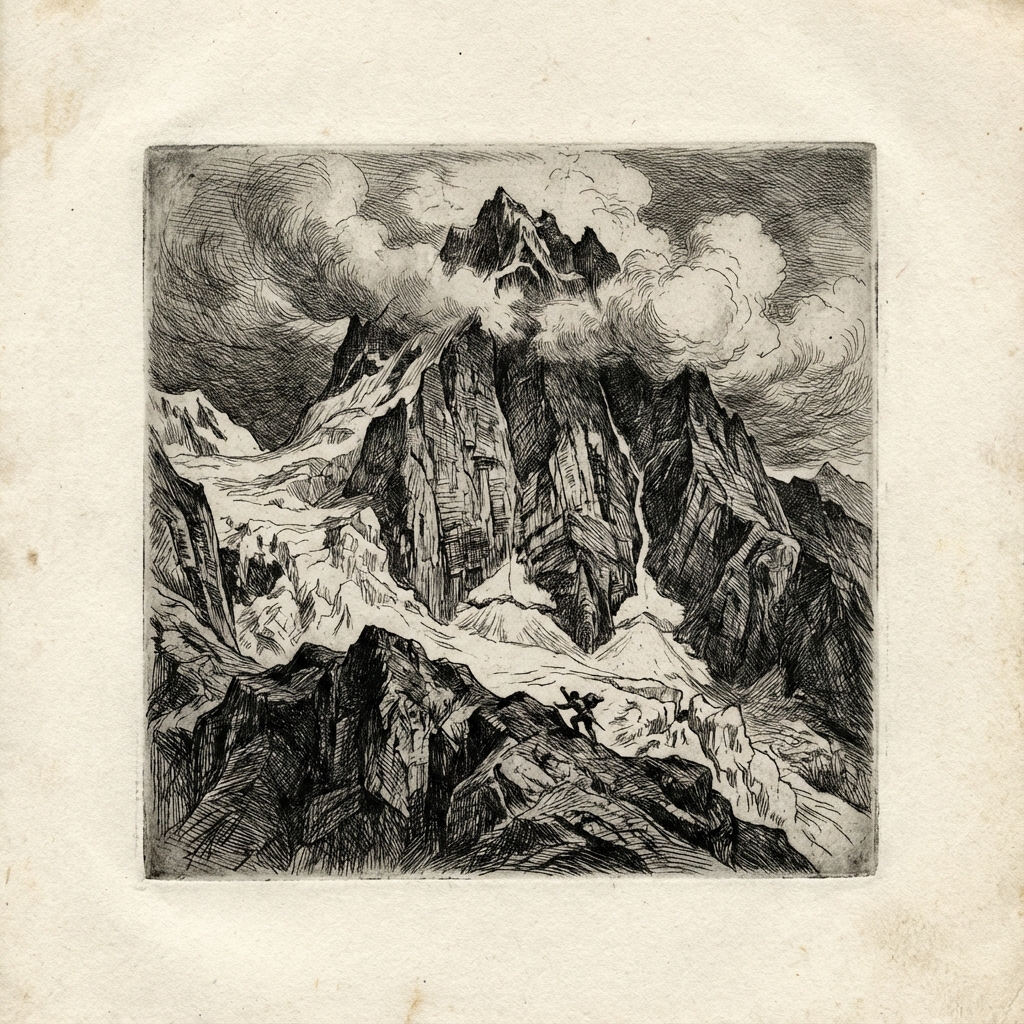
But it is not so bad. The mountain is real, the climb is steep, and the company is good. And the view from here, partway up, already justifies the effort.