The Sacred Mountain Is Scaffolding
〞Cómo citar este artículo:
APA (7ª edición)
Spencer, H. (2026, August 17). The Sacred Mountain Is Scaffolding. En {dp} · doble página. https://herbertspencer.net/2026/the-sacred-mountain-is-scaffolding. Visitado en:
MLA
Spencer, Herbert. "The Sacred Mountain Is Scaffolding." {dp} · doble página, 17 August 2026, https://herbertspencer.net/2026/the-sacred-mountain-is-scaffolding. Accedido el .
Chicago
Spencer, Herbert. "The Sacred Mountain Is Scaffolding." {dp} · doble página. Publicado el 17 de August de 2026. https://herbertspencer.net/2026/the-sacred-mountain-is-scaffolding. Consultado el .
What I went for
I went to Auckland to do a doctorate in design. Twenty-two months later I have not encountered design. Not a version of it I would want to argue with, and not the minimum definition either.
The minimum is modest. Somebody proposes a form under constraints, puts it into the world, and answers for what comes back. That is the entry condition to the discipline, before any school, doctrine or methodology gets involved, and it is the one thing every designer alive would recognise as the work.
In twenty-two months nobody in my supervision, my reviews or my committees has proposed a form, examined one, or asked me a single question about the one I built. There has been a great deal of text about design, procedure about design, ethics documentation about design, and committee time about design. No design.
That is the finding, and it is worth more than my grievance. What follows is an account of how an institution comes to award doctorates in a discipline it has stopped practising, as far as I can tell
A correction
Eight months ago I wrote that the friction between practice and academic form was productive1. I wrote that the format is a form of integrity, that supervision is a form of translation, that the demand to compress your work into examinable language is a favour done to you by generous colleagues reading as examiners would read.
I meant it, and I was wrong in one specific place. I was writing about the format. The format is fine. A format is worth exactly as much as the people authorised to apply it, and the academy has built a magnificent machinery for ensuring that nobody is ever accountable for how they apply it. I called it a productive tension while standing inside a closed circuit engineered to be indistinguishable from rigour.
Through the back office
Here is the whole thing in one paragraph, since everything that follows is an attempt to understand it.
Nobody ever argued with my work. There exists no document, from any supervisor, reviewer or committee, stating what is wrong with the research. What happened instead was administrative. A signature withheld. An ethics pathway re-determined after the fact. A form completed and never returned. A verbal confirmation that the proposal had passed, reversed thirteen days later in writing that explains nothing. Each move is small, procedurally unremarkable, and individually deniable. Together they removed the ground the project was standing on, while the project itself was never touched.
That is the method, and it is worth naming precisely, because it is what makes it so hard to fight. They did not reject the work. They withdrew the floor beneath it, through the back office, where nothing has to be argued and nothing has to be signed. A rejection can be answered. A withdrawn floor cannot, since there is no claim on the table to answer.
And it was done while I was being told the work was going well. That is the part that took me longest to accept, and the reason I use the word treachery without hesitation. Everything that follows is my attempt to work out what kind of system makes that not only possible but comfortable.
The circuit
Here is the loop, described flatly. Any resemblance to institutions living or dead is a matter for the reader.
An academic founds a journal. He edits it. He also convenes a conference and chairs its committee. His doctoral students publish in the journal and present at the conference, and their publications are evidence of research activity under his supervision, which is evidence of his supervisory competence, which is what authorises him to judge whether somebody else’s work meets doctoral standard. When that somebody is assessed, the reviewers come from the same circle: people who publish in the journal, present at the conference, supervise alongside him, and whose own students he examines in return.
Nothing enters the loop from outside it. The system produces its own evidence, evaluates its own evidence, and grants itself the authority to keep doing both. I am told this is called quality assurance.
Nobody accepts an envelope. The whole thing is sincere, which is what makes it durable: from inside, the loop is experienced as scholarship, and the standards feel like standards, particularly to the person who wrote them.
A discipline without an outside
Every field has gatekeepers. What protects most fields from their own gatekeepers is an outside that is indifferent to reputation. Physics has the world, and the universe has never once been persuaded by a citation count. Medicine has the patient. Engineering has the bridge, and the bridge is unimpressed by who supervised you. These outsides keep authority provisional, so that somebody with no standing can be right and the field has a mechanism for finding out.
Design has an outside too, and it is plural, which is why it is so easily mislaid.
It begins with use: whether the thing works, for the person it is for, in the situation where they need it. It continues with reach, since accessibility is a condition of the thing’s existence and belongs in the first sketch. It asks whether people can take it up, adapt it, hand it on, use it for something you never intended, which is appropriability, and which separates a tool from a demonstration. It asks whether the thing can be sustained economically, socially and materially, because a proposal that survives only under the conditions of its own launch is a photograph of a solution.
It asks whether the thing is beautiful, which is a criterion. Beauty in a made thing is the visible evidence that its internal relations were resolved and not merely assembled, and everyone who works with their hands recognises it, whatever embarrassment the word causes in a committee.
It asks whether the thing is culturally just: whether it sits truthfully in the world that receives it or arrives as an imposition in local clothing. People in the Global South make that distinction at a glance, while in the North it circulates as an open research question.
And it asks what the thing sets off that nobody planned. Every artefact released into the world produces emergent behaviour, and that emergence is frequently the most important thing the work has to say. It is also unavailable in advance, by definition.
That last point governs the rest. No item on this list can be settled by argument beforehand, and together they cannot be predicted at all, so no committee can rule on them in advance. They become legible only in the encounter.
Design therefore proceeds by a method that gets mistaken for a temperament. You make. You put the thing into the world. You watch how the world receives it, including everything you hoped for and everything you did not. You contemplate that reception, which takes longer than anyone schedules and cannot be delegated. You reflect, and you go back into the making carrying what the encounter told you. Donald Schön called this a reflective conversation with the situation, and observed that the situation talks back2. The loop is design’s instrument in the way the telescope is astronomy’s.
Which gives the freezing of a research project its proper name. If iteration in the world is the only means by which design reaches its own criteria, an institution that stops the iteration has severed the discipline’s access to its outside, and then complains, with a straight face, that the criteria have not been met.
That outside is slow, plural, situated and impossible to fit inside an academic calendar, so it was quietly dropped from the criteria, in the way inconvenient things are dropped: not by decision, and not in writing. Remove it and nothing remains in design that can contradict a professor. What is left is taste, vocabulary and standing, and standing is what the circuit manufactures. Vacuums, as we know, do not stay empty.
Who occupies a vacuum
The people who rise in a discipline with no internal validation are the ones who can operate the apparatus.
They are formidably competent at something. Their real craft is the funding application, the ethics form, the editorial board, the special issue, the committee, the institutional memorandum, and the university rewards that skill lavishly because it is the skill the university itself runs on. Their output is procedure. The difficulty is that they occupy chairs with the word design on them, and from those chairs they get to say what design is.
So a model of doctoral work has spread that suits the apparatus beautifully. Students, very often the most exposed ones, migrants, first-generation candidates, people from communities the university is under pressure to be seen including, are invited to make their own identity, inheritance and pain into the material of the thesis. The apparatus adores this material for structural reasons: lived experience is infinitely available, needs no laboratory, no fieldwork budget, no industry collaborator who might return your call and say the thing does not work, and above all it cannot be contradicted from outside. Nobody can inform you that your own experience failed to replicate, so the work can always be validated, by the same circuit, on time.
Identity is legitimate material, and some of the most consequential design scholarship of the last thirty years has come from exactly there. The problem lies with an institution that has worked out it can graduate people cheaply by pointing them at the one resource they cannot be dispossessed of, and then filing the result under contribution to the discipline. That is extraction with a lanyard on, and the students are what is being spent.
The knowledge they will not look at
Design has its own form of knowledge, a specific epistemic operation that no other discipline performs, and it is the reason design belongs in a university.
You hold a set of incompatible constraints simultaneously, without resolving them prematurely, and you propose a form. The form is a claim: given all of this at once, here is a way the world could be arranged. The proposal then meets reality, reality objects, and the objection teaches you something no amount of prior analysis could have told you, because the knowledge did not exist until the proposal existed. Making is how a certain class of question becomes askable. Which is why a system demanding that every outcome be specified before the work begins selects with great efficiency against the work worth doing, and trains a generation to propose only what they already know how to finish.
Examining that is hard, and I have sympathy for anyone attempting it. Sympathy runs out where the difficulty stops being engaged and becomes a reason to look away, because looking properly would require the examiner to have made something recently and to be willing to be wrong in front of a student about a thing that exists and can be tested. The circuit offers a more comfortable alternative: assess the description of the practice instead of the practice. Nobody has to open anything.
That refusal is the engine of the wider crisis. Once a discipline stops assessing what was made and starts assessing how well it was narrated, everybody follows the incentive, and we become superb at describing work we have not done. The bluff is the product. The critics who say the university is selling smoke are increasingly correct, they have the evidence, and every year the evidence gets easier to gather.
Harry Frankfurt drew the distinction3. The liar knows the truth and conceals it. The bullshitter has no relationship to the truth at all and produces whatever the situation rewards. A closed validation circuit manufactures the second kind, awards them doctorates, chairs and editorships, and eventually gives them the power to decide whether your work is any good.
No school, only alignment
What ought to exist in a place like this is a school of thought: an argument sustained collectively over years, in which several serious people disagree productively and in public, and where a candidate participates in the disagreement instead of applying to it. That requires hospitality, an appetite for being contradicted by somebody twenty years younger who has built the thing you theorised about, and the willingness to read a student’s work expecting it might change your mind.
What exists is alignment. There is a house position, never written anywhere you could quote it back, and your task is to arrive at it unaided while being encouraged to find your own voice. Failure to arrive is diagnosed as failure to understand, and you are told there are codes of the doctorate you have not grasped, codes which evaporate the moment you ask for them, because articulating them would make them arguable.
The word for this is charlatanry, used technically. A charlatan has arranged matters so that his competence can never be tested. Gatekeeping in design education now sits largely with people who have not made anything in years, who are insulated from the needs of practice, and who are absent from the contemporary ethical debate in the discipline. That debate is urgent and concerns automation and labour, extractive data practice, accessibility as a right, who is authorised to represent whom, and what a designer owes the person who has no choice but to use what we build. It is happening in studios, standards bodies, disability communities and code repositories, and it is not happening in the committee deciding my candidature.
The twenty-minute test
These institutions have never possessed more ethical apparatus: committees, forms, amendments, delegated authorities, appeal pathways, a decline letter with a reference number. They have never been emptier of ethics as a disposition, which is older and simpler, and which consists of not wasting a person’s years, not putting your name to what you have not read, and not using a procedure you control to stop work you are unwilling to argue with in the open. The apparatus is what makes the hollowness survivable, since it distributes responsibility so finely that no one is left holding any.
The disposition has a test, available to anybody, and it takes twenty minutes. A person who loves the craft opens the thing you built. They click on it, they try to break it, they come back to tell you the spacing is wrong on the third screen or to ask why you resolved that transition the way you did.
Build a working system. Publish it. Put the link in front of the people responsible for supervising it, more than once, over months, in three different formats.
Reader, they did not open it.
That is information. They were not withholding judgement on my work. They have no relationship to work of that kind at all, and never did.
Thoughtlessness, and the refusal that nobody signs
Everything above concerns individuals. The serious part concerns the institution, and it is the part I did not expect.
Put evidence of bad faith in front of a university, in writing, with dates, and the institution metabolises it. The conduct becomes a difference of opinion between a student and his supervisors, the documented reversal becomes an unfortunate misunderstanding, the unsigned form becomes a matter still under consideration. Nothing is denied, since denial would require somebody to assert something and assertions can be checked. The whole thing is gently rendered procedural, and once it is procedural it can be administered indefinitely.
The instinct at work is self-preservation, and it is stronger than rigour, because the alternative is an institution conceding that one of its own academics acted in bad faith, which no organisation does voluntarily while a procedural route to not doing it remains available. The evidence sits there, unrefuted and unaddressed, and the machine hums.
Hannah Arendt gave us the vocabulary, and her useful contribution is the mechanism underneath the famous phrase. She described thoughtlessness: the inability to think from the standpoint of somebody else4. The functionary does his job, does it well, and the part of the mind that would ask what the job is doing to a particular person is simply not switched on. Everybody in the chain behaves reasonably and the outcome is unreasonable, with no individual step accounting for it.
On bureaucracy she was blunter: rule by Nobody, a tyranny without a tyrant, and the most complete of them, since nobody is left who could even be asked to answer for what is being done5.
Rule by Nobody describes exactly what has been done to my candidature, and explains why the harm is so hard to name. Nobody in an institution like this ever says no. They say not yet, they say there are some concerns, they say the committee will need to look at it again, they do not sign, they do not reply, and they let deadlines pass until time performs the refusal nobody was willing to put a name to. A refusal nobody signs is a refusal nobody answers for, and it damages a person as thoroughly as an honest rejection while leaving no one responsible for the damage.
The consequence runs forward, which the institution has not calculated. Once you have watched an organisation choose its own preservation over the evidence in front of it, every future assurance from that organisation becomes a claim requiring verification. The grounds are empirical. It behaved this way when the facts were clear and documented, and the inference about next time is not difficult.
The stick in the spokes
Supervision rests on an asymmetry so severe it can only function on trust. One party holds the signature, the reference, the scholarship, the visa, the professional network and the definition of good work. The other party hands over four years of their life. No contract makes that safe. It runs on good faith or it does not run.
Consider what it takes to say, in writing and in meetings, over months, that you support the research and want to see it advance, while working out how to stop it. To watch somebody build the thing anyway, in the evenings, in another hemisphere, and to answer by locating the point in the machinery where a small omission has a large effect. The stick goes into the spokes exactly when the bicycle is moving well, and its virtue, from the point of view of the hand holding it, is that a stick in the spokes leaves no record of a hand.
The project advanced despite the supervision, and I think that was the offence. Nothing else accounts for the shape of it.
Then the student puts the sequence in front of the institution and the institution defends them by procedure. That is the part I have not managed to be philosophical about. I chose this university because I believed it was not in the business of bullshit, I said so publicly, and I brought a fifteen-year institutional relationship with me. Discovering that the grey machinery exists mainly to ensure nobody has to look at what happened is a disappointment of an unfamiliar size. Two people are ordinary. An institution that read the file and decided the file was the problem is something else.
What would actually validate design
Design has an internal criterion available to it, harder than the borrowed ones, and adopting it would make the circuit irrelevant instead of infuriating.
The artefact exists. It has met the world on the full set of terms above and not on a subset chosen for convenience. And it carries inside itself the traceable record of the decisions that produced it, together with an account of what the encounter returned, including the parts nobody planned and the parts that went badly.
That last clause is the one design usually skips, and it is the one that does the work. A made thing that documents its own construction is not asking to be believed. It can be examined by a stranger, in ten years, with the maker absent and the maker’s supervisors vouching for nothing. It is evidence anybody can enter from outside, and a committee declining to look at it cannot un-make it.
Design does not need permission to hold itself to that standard. It needs to stop asking for permission, which is harder, because a great deal of institutional comfort depends on the asking.
The oldest artificial intelligence
This argument arrives now because of what is about to happen to every institution described above.
The public conversation about artificial intelligence turns on one fear: a system that pursues an objective without judgement, optimises the measurable proxy instead of the thing the proxy stood for, produces fluent and confident output bearing no relationship to whether the output is true, and cannot be held responsible for any of it because there is nobody inside it to hold. We have lived inside such systems for about a century and we call them organisations.
An institution is an information-processing machine built out of people. It takes inputs, runs them through rules, and produces decisions that no member authored and most would not have made alone. The members are the substrate, each following local instructions, seeing a fragment, unable to observe the global behaviour, which is roughly the condition of a neuron. It runs an objective function nobody wrote down and everybody serves: continuity, procedural legibility, the avoidance of embarrassment. It produces confident accounts of its own reasoning, assembled after the decision, describing a deliberation that did not occur. And it is unalignable in the way we now fear, since there is no location inside it where you could go to correct it.
Stafford Beer handed us the instrument: the purpose of a system is what it does6. Not the strategic plan, the values page or the welcome letter. What it does, reliably, over years. A system that reliably produces stalled candidatures, unsigned forms and unanswered evidence is performing its function. The mission statement is the interface, and it is a very good interface, which is why it took me eighteen months to look behind it.
Which raises the question that matters. How does an organisation learn?
Chris Argyris and Donald Schön drew the distinction7. Single-loop learning adjusts the action to hit the existing target. Double-loop learning asks whether the target was right. Organisations excel at the first and are structurally close to incapable of the second, since double-loop learning requires conceding that the governing values were wrong, and those values are embodied in people with titles.
Argyris also named the guarantee of failure: defensive routines, skilled and automatic actions whose purpose is to avoid embarrassment and whose reliable effect is to make learning impossible. An institution that answers documented evidence with a procedure is not being hostile. It is executing a defensive routine that nobody selected and everybody experiences as care.
So organisations correct themselves mostly by waiting for the people who embody the error to retire.
Now add amplification, which is never neutral. A system adopts a new technology to do what it already does, faster and cheaper. Put a language model inside a self-validating circuit and you get an unlimited supply of scholarship-shaped output at almost zero marginal cost, so the bluff, previously expensive and therefore rationed, becomes free.
The point where this stops being speculation is small and easy to miss: the moment the feedback a student receives on their work is generated by a machine. The loop then closes completely, with a text nobody wrote assessing work nobody read inside a procedure nobody answers for. Every box ticked, every deadline met, and no human being anywhere in the chain who has looked at the thing that was made.
We are about to make institutions very much faster. These are the mechanisms we would be making faster.
The last problem for design
Herbert Simon defined the field better than anyone since: everyone designs who devises courses of action aimed at changing existing situations into preferred ones8. An admissions process is a design. A supervision agreement is a design. An ethics pathway with delegated authorities, amendment routes and appeal windows is an interaction design with states, control points, error handling and failure modes, used under duress by people whose lives turn on the outcome.
These accreted. Which is how you end up with an interface whose error state is a person losing two years of their life, displaying no message.
Design owns this problem and has been somewhere else. While the discipline wrote about itself in journals it also edits, the most consequential designed artefacts in the world, the procedures through which people are admitted, assessed, funded, treated, deported and refused, were left to accumulate unattended, and are now about to be automated by people who have never been asked to consider them as artefacts.
Designing an institution capable of learning takes what any system takes when it must be trusted with a decision it cannot be argued out of. Expose the intermediate representations, so reasoning can be inspected while it is forming. Log the interventions, so every change to a decision carries an author and a time. Make responsibility signed, so a refusal has a hand on it. Keep open a channel through which outside evidence reaches the decision without needing permission from the party the evidence concerns. Build a cascade of invalidation, so that when something upstream changes, everything downstream is marked stale until somebody looks again, instead of quietly retaining the authority of a judgement whose basis has evaporated.
I notice that I have just described the tool I built.
I set out to make pictogram construction visible, so that a professional remains the author of every step and the record of how a thing was made travels with the thing. It is the same problem at a different scale. The institution that could not bring itself to open my prototype is the institution that most needs its architecture.
Disobedience
I still believe most of what I wrote in December. Compression is a discipline, a format can be a form of integrity, and word should rhyme with act. What I no longer believe is that those commitments are safe with the people currently authorised to enforce them. The format was used, by people with no demonstrated relationship to the craft it protects, as an instrument for stopping work they did not want to read.
So this is a refusal. Continuing to build while the machinery says wait is a small act of disobedience, and it is the correct thing to do, for a reason that took me a while to trust. I have been honest, coherent and transparent from the first day, everything I have done is documented, published, timestamped and open, and there is nothing in the record I would need to explain away. It is the strongest position available, since the entire method of the other side depends on there being no record.
The masks are off, which is a relief. For a long time I assumed the problem was me: that I had failed to make the work legible, that I was missing something obvious, that a more articulate candidate would have got through. That assumption kept me polite for eight months longer than the facts warranted. The work was legible all along. It arrived in front of people who had no intention of looking at it and who needed it to fail for reasons unrelated to its quality.
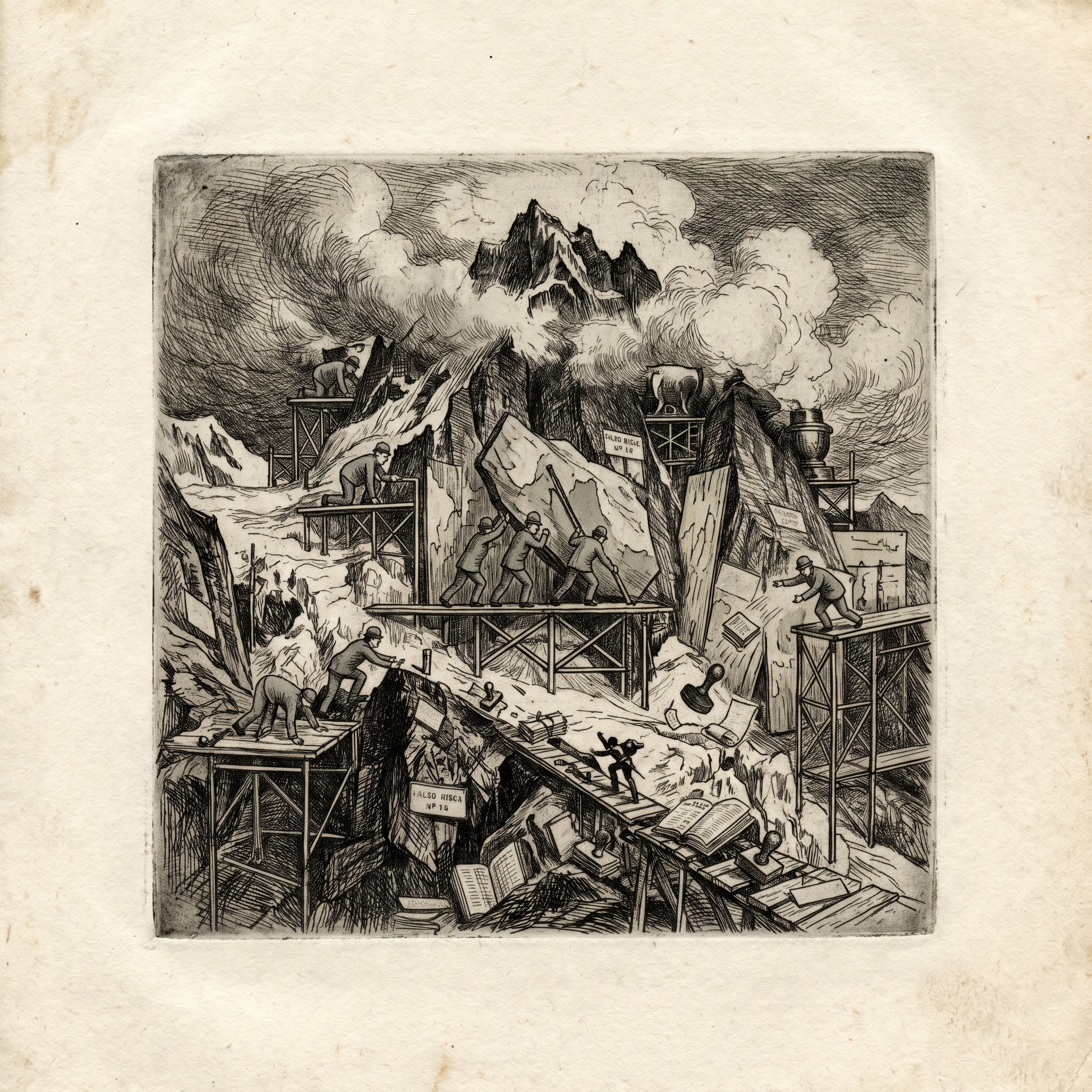
So the mountain is not sacred. A good deal of it is scaffolding, put up by people who have never made the climb, who found that from high enough on the structure nobody can tell the difference, and who become noticeably anxious when somebody starts climbing the rock.
I am still climbing. I went to AUT for design and did not find it in the building. I have stopped asking the people on the scaffolding whether the work is any good, because that question has an outside, and the people it belongs to are already using the thing.